
About the journal
UCL Open Environment is a fully open access, peer-reviewed journal committed to tackling environmental challenges through transparent, inclusive and multi-disciplinary publishing that showcases radical and critical thinking on real-world issues, with the overall aim of benefitting humanity.
We support researchers, practitioners, and policy professionals working across diverse environmental domains from Planetary Health and Public Health to Climate Science and Ecology and Biodiversity. Our publishing model is shaped by three principles: openness, fairness, and relevance to real-world impact.
- Aims and Scope
- What we publish
- Editorial process and Peer Review
- Acceptance criteria
- Open Access and Licensing
- Funding and Diamond OA – no article publication charges (APCs)
- Discoverability and Indexing
- Journal metrics
- Journal Details
- Contact and Community
Aims and scope
The journal welcomes submissions across all aspects of environment-related research and the generation of new knowledge. Articles will be judged on the merit and scientific validity (sound scholarship) of the work and the Editorial Board are inviting submissions from people at any research or knowledge-based organisations (including NGOs, Think Tanks, IGOs/UN) and at all career stages, including early career researchers, mid-career professionals, and senior scholars.
The journal’s scope includes environment-related studies linked to:
- Past, present, and future environmental processes and characteristics viewed from a theoretical, observational, or experimental perspective
- The planet’s environments, including those in which people live
- Interactions between the environment and people’s wellbeing and health, including the impacts and management of pollution or disease mediated via the environment
- Policies, decisions, behaviours, mechanisms, and approaches to the way the environment and its resources are managed, including those dealing with the evidence linked to global challenges such as Climate Change, Biodiversity Loss and overall Environmental Degradation as well as to international endeavours related to the One Health, Planetary Health/Limits and Sustainable Development
- Research methods and approaches, the development and management of databases and the development and work of networks.
We publish work within the inter- and multi-disciplinary knowledge space created by two axes, one spatial and one temporal:
Temporal: From the past (including what we can learn from the past) through to the present and out into the future (as far as we can make projections about the future), and;
Spatial: The global to local reach of societal challenges and the solutions that can help ensure that humanity can live within constraints of planetary systems.
We welcome work situated within and across disciplines, including submissions grounded in theoretical, observational or experimental approaches. Inter- and multi-disciplinary contributions are especially encouraged, though strong single-discipline articles that fall within scope may also be considered.
What we publish
We welcome a wide range of content formats, including:
- Research articles
- Systematic Reviews
- Methodology articles
- Commentaries
- Research Protocols
- Case studies
Our scope is deliberately broad to support the evolving ways in which environmental knowledge is produced and communicated – across disciplines, sectors and communities. The core themes of the journal have four dimensions that provide an indicative focus for submissions. The descriptions provided in the table, below, are designed to guide authors and are not exhaustive descriptors within the area of research.
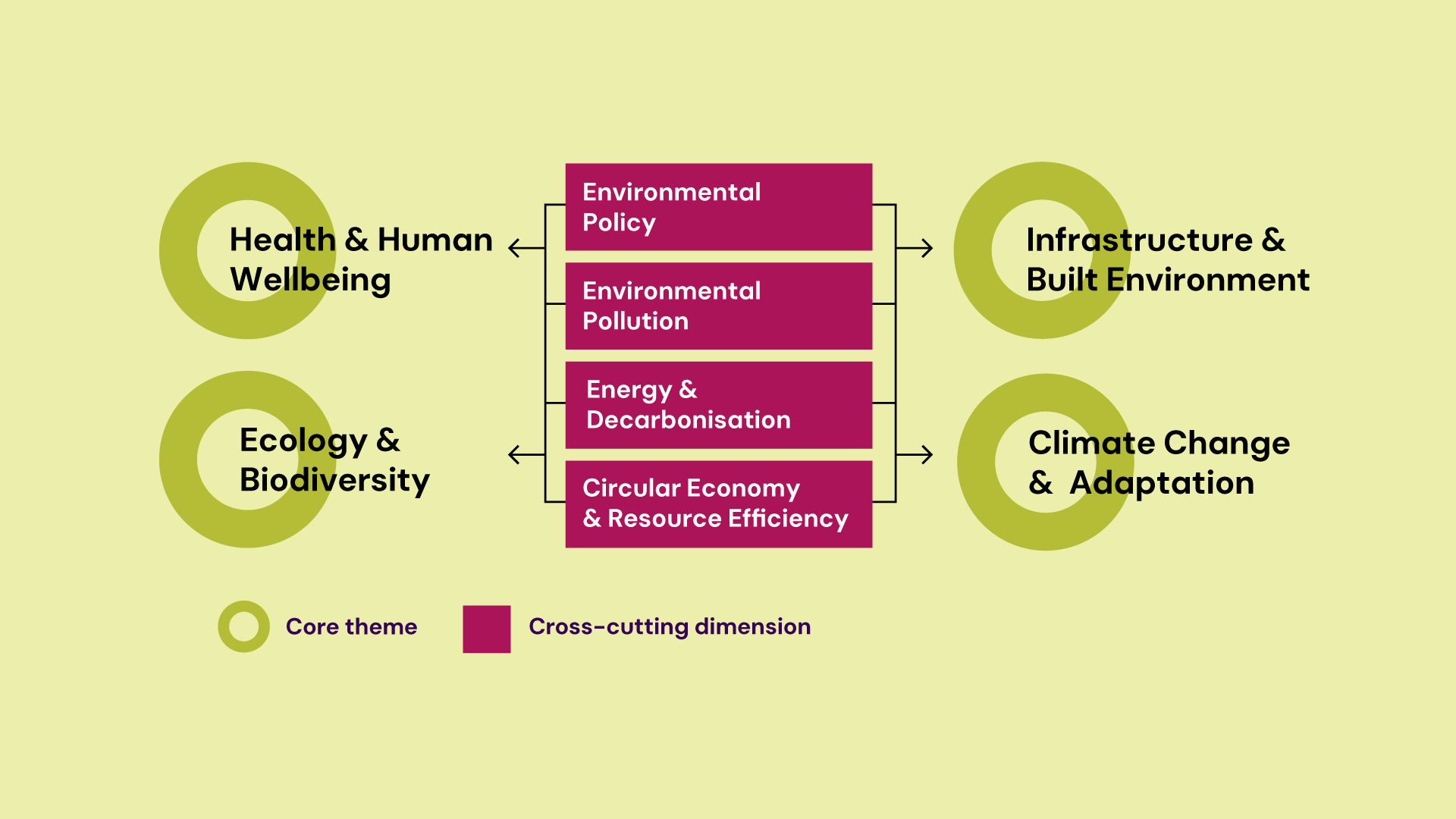
| Core theme | Cross cutting dimensions |
|
Health & Human Wellbeing
|
Ecology & Biodiversity.
|
|
Environmental policy.
|
Environmental Pollution.
|
|
Infrastructure & the Built Environment.
|
Energy & Decarbonisation.
|
|
Climate Change & Adaptation
|
Circular economy & Resource Efficiency
|
Author guidelines
Editorial process and Peer Review
We operate a two-stage model combining preprints and open peer review:
1. Preprint publication
- Articles approved for peer review by the editorial board are published immediately as Preprints (under peer review).
- These are citable and openly available to show the evolution of a manuscript under review.
2. Open peer review
- Reviewer names and their reports are published online under the CC BY licence and with a DOI – these are citable and openly available alongside the preprint manuscript.
- Authors' responses to peer reviews are posted online, when revised.
- Most manuscripts require a couple of rounds of review due to their inter- and multi-disciplinary nature.
We aim to support a fair and open review process that improves the quality of submissions and enhances trust in published research.
Learn more about how it works:
How it works
Acceptance criteria
We assess submissions based on:
- Relevance to our aims, scope and mission.
- Clarity and soundness of argument and findings.
- Evidence of new knowledge and meaningful contribution to the field.
- Responsiveness to reviewer and Editorial feedback.
Submissions are unlikely to be accepted if they:
- Are primarily commercial or self-promotional.
- Contain excessive self-citation.
- Lack clear conclusions or conceptual rigour.
- Provide minimal updates on prior work.
- Are not suitable for peer review due to clarity or fit with the journal.
Articles accepted for full publication will be those where the Editorial Board has received at least two favourable peer reviews and is satisfied that all reviewer and Editorial comments have been adequately addressed.
Experience suggests that few submissions are accepted after a single review round. The Editorial Board may decline a submission at any stage if reviewer concerns cannot be addressed to the Board’s satisfaction. In some cases, Editors may request revisions before peer review to support review effectiveness.
For more context, see this letter from the Editor-in-Chief.
Preprints
UCL Open Environment is happy to accept submissions of papers that have been loaded onto preprint servers or personal websites, have been presented at conferences, or other informal communication channels. These formats will not be deemed prior publication. Authors must retain copyright to such preprints and are encouraged to link any prior posting of their paper to the final published version within the journal, if it is editorially accepted. This will not affect the journals open peer review process.
Further information about self-archiving your article on preprint servers can be found on the UCL Press editorial policy pages:
Editorial policies
Open Access and Licensing
All content is published under a Creative Commons Attribution 4.0 International (CC BY 4.0) licence. This ensures:
- Free access for readers worldwide.
- Retention of copyright by authors.
- Maximum flexibility for reuse, adaptation and sharing.
We follow the Budapest Open Access Initiative and are committed to author rights and open scholarship. Our Author Contributor Agreement outlines full terms for publication:
Author Contributor Agreement
Funding and Diamond OA – no article publication charges (APCs)
UCL Open Environment is a Diamond Open Access journal, meaning that UCL Press does not levy any Article-Processing Charges (APCs) for submission or publication.
UCL Press covers all the costs to publishing every article and publishing is free at every stage:
- No submission fees
- No peer review fees
- No publication fees
This reflects our commitment to equity and non-profit publishing, especially for authors with limited funding or from underrepresented sectors.
Additional funding and support
The publication of this journal was supported by the Wellcome Trust.
Discoverability and Indexing
UCL Press works with subject specific indexers to deposit published articles in relevant repositories and search databases.
Published articles are indexed in major databases, including:
- PubMed Central
- Scopus
- CAB Abstracts / Global Health (CABI)
- Directory of Open Access Journals (DOAJ)
- Dimensions
- EBSCO
- ERIH+
- Google Scholar
- Baidu
- OCLC
- Portico and CLOCKSS (for long-term preservation)
Preprints are also indexed in Google Scholar, Baidu, Dimensions and archived in Portico and CLOCKSS (for long-term preservation).
Journal metrics
We are committed to the responsible use of metrics and strongly encourage all readers, authors, reviewers, and Editors to read through our statement about the use of metrics across the journal, available online at https://journals.uclpress.co.uk/site/editorial_policy/#METRICS.
Citation metrics
- Scopus CiteScore (2025 tracker) 3.0
- Scopus SJR (2025) - Not yet released
- Scopus SNIP (2025) - Note yet released
Journal Details
ISSN: 2632-0886
Publication frequency: Continuous (as and when ready)
Average time to publication: ~25 weeks
Published by
UCL Press, University College London (UCL)
Gower Street, London WC1E 6BT, UK
Contact and Community
We are a community-led journal. Whether you’re submitting, reviewing, or simply reading, we invite you to be part of our network.
For pre-submission enquiries:
uclopen.environment@ucl.ac.uk
Stay connected:
Bluesky: @ucloe.bsky.social
X/Twitter: @uclopen_env
LinkedIn: https://www.linkedin.com/company/ucl-open-environment